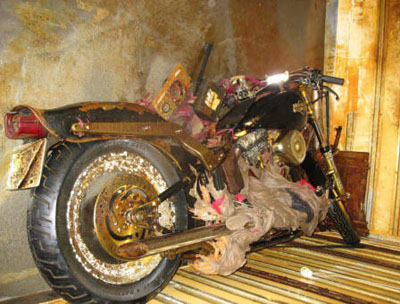
Tsunami bike to be displayed at Harley museum
MILWAUKEE (AP) — A Harley-Davison motorcycle that drifted 4,000 miles across the Pacific Ocean after last year’s tsunami in Japan will be preserved at the company’s museum in Milwaukee.
The 2004 Softail Night Train bike was found after it washed ashore in an insulated cargo container on a remote beach on British Columbia’s Graham Island. The motorcycle still had its Japanese license plate which was traced to its owner, Ikuo Yokoyama, who had lost three relatives and his home in the tsunami.
When Harley-Davidson offered to restore the bike for Yokoyama, the 29-year-old decided it might better be preserved in Harley’s museum as a memorial to the tragedy that claimed more than 15,000 lives.
The man who found the bike, Canadian Peter Mark, says it’s fitting that the motorcycle be preserved in its current state at the museum.
U.S. braces for tsunami debris, but impact unclear
JUNEAU, Alaska — More than a year after a tsunami devastated Japan, killing thousands of people and washing millions of tons of debris into the Pacific Ocean, the U.S. government and west coast states don’t have a cohesive plan for cleaning up the rubble that floats to American shores.
There is also no firm handle yet on just what to expect.
The Japanese government estimates that 1.5 million tons of debris is floating in the ocean from the catastrophe. Some experts in the United States think the bulk of that trash will never reach shore, while others fear a massive, slowly-unfolding environmental disaster.
"I think this is far worse than any oil spill that we’ve ever faced on the west coast or any other environmental disaster we’ve faced on the west coast" in terms of the debris’ weight, type, and geographic scope, said Chris Pallister, president of a group dedicated to cleaning marine debris from the Alaska coastline.
David Kennedy, assistant administrator for the National Oceanic and Atmospheric Administration’s (NOAA) National Ocean Service, told a U.S. Senate panel that in most cases debris removal decisions will fall to individual states. Funding hasn’t been determined.
U.S. senator Mark Begich (D-Alaska) and other west coast political leaders have called that scenario unacceptable, saying tsunami debris poses a pending national emergency. "If this was a one-time event all at once, we’d declare it an emergency and we’d be on the ground like that," he said, during the hearing he led.
One astonishing example of how the unexpected can suddenly appear occurred this month in Oregon when a concrete and metal dock that measured 66 feet long, seven feet tall, and 19 feet wide, washed ashore a mile north of Newport. A Japanese consulate official in Portland confirmed the dock came from the northern Japanese city of Misawa, cut loose in the tsunami of March 11, 2011.
"I think that the dock is a forerunner of all the heavier stuff that’s coming later, and amongst that heavier stuff are going to be a lot of drums full of chemicals that we won’t be able to identify," Pallister said.
His group, Gulf of Alaska Keeper, works in the same region devastated by the Exxon Valdez oil spill, which dumped 11 million gallons of oil into Prince William Sound in 1989.
Tsunami debris is tough to monitor. Winds and ocean currents regularly change, while rubbish can break up. Some trash, like fishing gear, kerosene, gas containers, and building supplies, can be tied to the tsunami only anecdotally. But in other cases — a soccer ball and a derelict fishing boat in Alaska and a motorcycle in British Columbia, for example — items have been traced back to the disaster through their owners.
NOAA projects the debris having spread over an area roughly three times the size of the contiguous United States, but can’t pinpoint when or how much might eventually reach the coasts of Alaska, Washington, Oregon, California, and Hawaii.
An independent group of scientists and environmental activists are scheduled to sail aboard the Sea Dragon from Japan to an area north of the Hawaiian islands, with plans to zigzag through the debris, document what’s floating, and try to determine what might reach the west coast.
"You have a unique experiment," said Marcus Eriksen, a researcher at the Algalita Marine Research Institute in Long Beach, California, who is leading the expedition. "You have entire homes and all their contents ... anything you may find in a Japanese home could be floating in the ocean still intact."
Seattle-based oceanographer Curtis Ebbesmeyer, who has been tracking ocean trash for 20 years, predicts the main mass of tsunami debris will reach the U.S. coast from Northern California to southeast Alaska as early as October, with the beginning of fall storms.
Cleanup plans should be finalized no later than September, Ebbesmeyer cautioned. There may also be sensitive issues to be decided, he said, including how to deal with any human remains or personal mementos.
But just who will clean up the debris and who will pay for it hasn’t been fully determined.
Begich wants to make at least $45 million available for local community groups to conduct cleanup efforts. Gulf of Alaska Keeper believes congress should set aside $50 million a year for four years.
As it stands now, NOAA has $618,000 allocated to clean up tsunami debris. The agency’s total marine debris program budget could drop by 26 percent to $3.4 million under President Obama’s proposed budget.
Marine trash isn’t a new problem. The ocean is littered with all kinds of things that can trap and kill wildlife, hurt human health and navigation, and blight beaches.
NOAA has previously given grants to local groups for cleanup work. The agency expects the tsunami debris to simply add to the ongoing problem of massive amounts of trash flowing into the ocean every day.
Volunteers in California report their efforts being stretched thin just in dealing with day-to-day rubbish. Seasonal opportunity for cleanup could close as early as September at spots in Alaska, where some beaches are accessible only by boat or aircraft and removing trash can be difficult and expensive. Washington has monitored some incoming debris for radioactivity.
Eben Schwartz, marine debris program manager for the California Coastal Commission, said more recognition needs to be given to the fact that it will be beach cleanup volunteers who respond to tsunami debris.
"Given that, I would like to see more state and federal support for the volunteer programs that will be taking the lead," he said. They’re going to need help, resources, and funding, he added.
NOAA’s marine debris program expects solid plans from the states within the next few months. The governors of Washington, Oregon, and California, as well as the premier of British Columbia, have said they will work together to manage debris.
Widespread or concentrated die-offs of marine animals aren’t expected, said John Hocevar, oceans campaign director for Greenpeace, but there could be local impacts.
NOAA officials say they don’t think there’s any radiation risk from the debris, despite the meltdown at a nuclear power plant in Fukushima.
Merrick Burden, executive director of the Marine Conservation Alliance in Alaska and Washington, said he thinks states, local governments, volunteers, and industries including fishing and tourism need to pull together to clean up debris, and not simply wait and hope for federal funds. "One of the things standing in the way is a unified, coordinated approach to this," he said.
Pallister worried that a lack of awareness may hamper the effort. "You just don’t have that visceral, gut-wrenching reaction to having oiled otters and drowned seabirds in that crude to get the public pumped up about it," he said of the tsunami debris. "And even if you could get the public pumped up, again, you don’t have that culprit to go after — a bad guy. It’s kind of a tough one to deal with."
McAvoy reported from Honolulu. Associated Press writers Rachel La Corte in Olympia, Washington, Jeff Barnard in Grants Pass, Oregon, and Jason Dearen in San Francisco contributed to this report. |